CHAPTER 2
Microorganisms: Friend and Foe
Here is some important points and answer of chapter 2 (Microorganisms: friends and foe )NCERT science of class 8 which helps students to understand topics of chapter.The answer of textbook question of CHAPTER 2 MICROORGANISMS:FRIEND AND FOE OF CLASS 8 SCIENCE NCERT help students to better understand the topics of chapter.
Keynotes of CHAPTER 2 OF CLASS 8 SCIENCE:
Answers of chapter 2 are here
Exercise Questions
1. Fill in the blanks.
(a) Microorganisms can be seen with the help of a ____________.
(b) Blue green algae fix __________ directly from air and enhance fertility of soil.
(c) Alcohol is produced with the help of __________.
(d) Cholera is caused by __________.
Soln:
a) Microscope
b) Nitrogen
c) Microorganisms
d) Bacteria
2. Tick the correct answer.
(a) Yeast is used in the production of
(i) sugar (ii) alcohol (iii) hydrochloric acid (iv) oxygen
(b) The following is an antibiotic
(i) Sodium bicarbonate (ii) Streptomycin (iii) Alcohol (iv) Yeast
(c) Carrier of malaria-causing protozoan is
(i) female Anopheles mosquito (ii) cockroach (iii) housefly (iv) butterfly
(d) The most common carrier of communicable diseases is
(i) ant (ii) housefly (iii) dragonfly (iv) spider
(e) The bread or idli dough rises because of
(i) heat (ii) grinding (iii) growth of yeast cells (iv) kneading
(f) The process of conversion of sugar into alcohol is called
(i) nitrogen fixation (ii) moulding (iii) fermentation (iv) infection
Soln:
a) (ii) alcohol
b) (ii) Streptomycin
c) (i) female Anopheles mosquito
d) (ii) housefly
e) (iii) growth of yeast cells
f) (iii) fermentation
3. Match the organisms in Column A with their action in Column B.
| A | B |
| (i) Bacteria | (a) Fixing nitrogen |
| (ii) Rhizobium | (b) Setting of curd |
| (iii) Lactobacillus | (c) Baking of bread |
| (iv) Yeast | (d) Causing malaria |
| (v) A protozoan | (e) Causing cholera |
| (vi) A virus | (f) Causing AIDS |
| (g) Producing antibodies |
Sol:-
| A | B |
| (i) Bacteria | (e) Causing cholera |
| (ii) Rhizobium | (a) Fixing nitrogen |
| (iii) Lactobacillus | (b) Setting of curd |
| (iv) Yeast | (c) Baking of bread |
| (v) A protozoan | (d) Causing malaria |
| (vi) A virus | (f) Causing AIDS |
4. Can microorganisms be seen with the naked eye? If not, how can they be seen?
Soln:
No,microorganisms cannot be seen by the naked eye because they are very small and are called microbes. They can be seen by using a microscope.
5. What are the major groups of microorganisms?
Soln:
Major group of microorganisms are as follows
- Bacteria
- Fungi
- Protozoans
- Algae
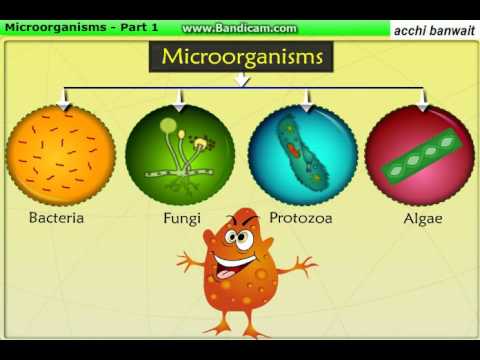
- Viruses
6. Name the microorganisms which can fix atmospheric nitrogen in the soil.
Soln:
Bacteria such as rhizobium and certain bluegreen algae present in the soil can fix atmospheric nitrogen and convert into usable nitrogenous compounds which are ysed by plants for the synthesis of plant proteins and other compounds.
7. Write 10 lines on the usefulness of microorganisms in our lives.
Soln:
Uses of microorganisms are listed below
- They are helpful in cleaning up of the environment. For example, the organic wastes (vegetable peels, remains of animals, faeces, etc.) are broken down into harmless and usable substances by bacteria.
- Curd contains several microorganisms. Of these, the bacterium, Lactobacillus promotes the formation of curd. It multiplies in milk and converts it into curd.
- Bacteria are also involved in the making of cheese, pickles and many other food items.
- Bacteria and yeast are also helpful for fermentation of rice idlis and dosa batter.
- Yeast reproduces rapidly and produces carbon dioxide during respiration. Bubbles of the gas fill the dough and increase its volume. This is the basis of the use of yeast in the baking industry for making breads, pastries and cakes.
- Microorganisms are used for the large scale production of alcohol, wine and acetic acid (vinegar).
- Antibiotics are being produced from bacteria and fungi.
- Microorganisms are helpful in producing vaccines against disease-causing agents.
- Some bacteria are able to fix nitrogen from the atmosphere to enrich the soil with nitrogen and increase its fertility.
- Microorganisms decompose dead organic waste of plants and animals to convert them into simple substances. These substances are again used by other plants and animals. Thus, microorganisms can be used to degrade the harmful and smelly substances and thereby clean up the environment.
8. Write a short paragraph on the harmful effects of microorganisms.
Soln:
Microorganisms cause diseases in plants and animals Ex; Cholera in humans is caused by bacteria called Vibrio cholera. In animals, the virus causes foot and mouth diseases. Microorganisms spoil the foods by decomposing the food material. Some microorganisms spoil leather and clothes. Microorganisms are responsible for food poisoning.
9. What are antibiotics? What precautions must be taken while taking antibiotics?
Soln:
The medicines that kill or stop the growth of the disease causing microorganisms are called antibiotics.
For ex. streptomycin ,tetracycline etc.
Following precautions must be taken while taking antibiotics:-
• antibiotics should be taken only on the advice of a qualified doctor.
• one must finish the course prescribed by the doctor.
•antibiotics must be avoided when not needed or in wrong doses.
This is the complete solution and some important points of CHAPTER 2 MICROORGANISMS:FRIENDS AND FOE OF CLASS 8 SCIENCE(NCERT).The soution is given according to latest syllabus of CBSE.
FOR ANY QUERY CONTACT US.
RELATED LINK
Comments
Post a Comment
Don't worry,We don't spam.